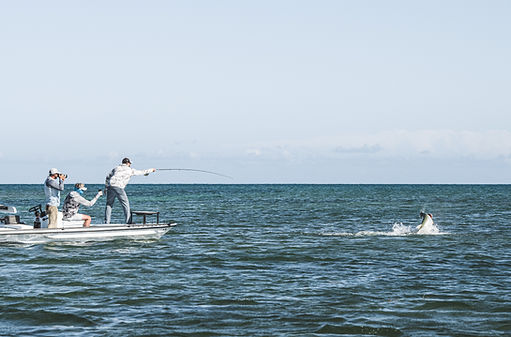
KEY WEST TARPON FLY FISHING


Chasing the Silver King: Fly Fishing for Tarpon in Key West, Florida
There are few experiences in saltwater fly fishing that compare with standing on the bow of a skiff in the Florida Keys, scanning the water for a flash of silver. Then, suddenly, a tarpon appears—rolling, cruising, or sliding across a shallow flat. The guide quietly calls out, “Tarpon,” and everything changes. The next few seconds are about reading the fish, making the cast, and putting a fly directly in front of one of the most powerful game fish in the ocean.
Key West is one of the world’s premier destinations for tarpon on fly, and for good reason. The combination of clear shallow water, abundant bait, deep channels, expansive flats, and seasonal migrations creates an environment where anglers can hunt tarpon visually rather than simply waiting for a bite.
When the Tarpon Are Around
Tarpon can be found around Key West throughout the year, but the famous migration generally begins in late winter and builds through spring. Resident and smaller tarpon can show up year-round, particularly around the backcountry, channels, and mangrove areas. The big migratory fish are what make spring so special.
March and April are often the beginning of the serious season. Early in the spring, large tarpon may be found “laid up” in backcountry basins, sometimes floating almost motionless in three to six feet of water. As the water warms, more migratory fish arrive. April, May, and June are generally the heart of the Key West tarpon season, with May often considered the peak of the migration. By late June and July, many of the larger migratory fish have moved on, while resident and juvenile tarpon remain available.
Water temperature is a major factor. Tarpon are most comfortable in warm water, generally around the low-to-mid 70s and above. Stable weather and warming water encourage fish to move into the shallows, while cold fronts and sudden changes can push them deeper.
Tides and Seasonal Patterns
Tides are critical because tarpon are often positioned where moving water delivers food to them. Incoming water can push bait onto flats and through channels, creating natural feeding lanes. Tarpon may hold along the edges of channels, basins, cuts, and shorelines, waiting for current to bring something edible within reach.
In the early spring, laid-up fish in the backcountry can be a primary target. These fish may barely move, giving an angler an incredible opportunity for a precise presentation. Later in the spring, the focus shifts toward migrating tarpon traveling along the Gulf and oceanside flats. Schools can range from a handful of fish to hundreds, and the sight of a massive school moving across shallow turquoise water is one of the defining experiences of Key West tarpon fishing.
The exact tide that is best can vary with location, wind, water clarity, and the behavior of the fish. Rather than simply fishing “high tide” or “low tide,” experienced guides pay attention to how the current is moving and where that current puts the bait.
The Art of Sight Fishing
Sight fishing is what separates tarpon fishing from simply fishing for tarpon. The goal isn't just to cast into likely water; it's to actually see the fish and make a presentation based on what it is doing.
A rolling tarpon may reveal itself by showing its back or silver side. A laid-up fish might be visible beneath the surface, while a traveling school can appear as a dark moving shape or a series of flashes across the flat.
Once the fish is spotted, the angler has to stay calm. The best cast is usually not directly at the fish. Instead, the fly is placed several feet ahead of a moving tarpon, allowing the fish to swim naturally toward it. The fly should enter the water quietly and then be moved with slow, deliberate strips. The objective is to make the fly appear as though it belongs there rather than startling the fish.
Fly Selection
Tarpon flies don't have to be complicated, but they need to imitate the food available and, most importantly, present naturally. Small baitfish patterns, shrimp, crabs, and other traditional tarpon patterns are all useful. Natural colors such as tan, olive, white, and muted combinations are popular, especially in clear water.
Fly size and weight should match the conditions. A fly that sinks too quickly can pass beneath a fish's feeding zone, while one that is too light may not get down quickly enough. The goal is to get the fly into the tarpon's path and keep it there long enough for the fish to make a decision.
Leader, Tippet, and Tackle
Big Key West tarpon demand serious equipment. Most dedicated tarpon anglers use 10-, 11-, or 12-weight rods paired with large-arbor reels capable of holding substantial backing. Floating lines are commonly used, although intermediate lines have an important place when fish are deeper or conditions require a faster-sinking presentation.
Leaders are typically built with a strong butt section, heavy fluorocarbon or monofilament, and a bite-resistant class tippet. A heavy shock or bite section is essential because tarpon have extremely hard mouths and tremendous power. Exact leader construction depends on the fish, fly, and regulations, but strength and abrasion resistance are never something to compromise.
The tackle isn't simply about stopping the fish. It is about having enough power to make long casts, turn over large flies, control the line, and eventually put enough pressure on a tarpon to bring the fight under control.
Casting and Boat Positioning
Casting is often the difference between a shot and a missed opportunity. Tarpon are fast, and once a guide spots a fish, the angler may have only seconds to react. The cast needs to be accurate, quick, and controlled. False casting too much can waste the opportunity and increase the chance of spooking the fish.
Boat positioning is equally important. The guide isn't simply driving toward the tarpon. The skiff has to be placed so the angler gets a clear casting lane and enough time for the fly to intersect the fish's path. Wind, current, depth, sunlight, and the direction of the tarpon all influence the approach.
The best guides essentially solve a moving equation: where is the fish going, where can the boat be positioned without disturbing it, and where does the fly need to land so the tarpon encounters it naturally?
What Makes Key West Tarpon Unique?
What makes Key West special is the combination of fish, habitat, and visibility. Few places allow anglers to pursue enormous tarpon in such shallow, clear water. During the spring migration, hundreds of fish can move through the Lower Keys, creating opportunities that are both visually spectacular and technically demanding.
There is also a unique mix of resident and migratory fish. An angler can encounter a small tarpon in a mangrove creek, a laid-up fish in a backcountry basin, or a school of hundred-pound-class tarpon moving across an oceanside flat—all within the same general region.
Jared's Experience
For Jared, the appeal of Key West tarpon fishing goes far beyond simply catching a big fish. It is the entire experience: the early-morning run across calm water, standing on the bow with a fly rod in hand, searching for the telltale flash of a rolling tarpon, and knowing that one good cast can turn an ordinary morning into an unforgettable one.
The most memorable part is the anticipation. Seeing a tarpon before it sees you creates a rush that is difficult to describe. Jared's experience has shown that tarpon fishing rewards patience as much as casting ability. A perfect presentation may be ignored, while a seemingly simple cast at exactly the right moment can result in an explosive eat.
And then comes the part every tarpon angler dreams about—the fly disappears, the line comes tight, and several hundred pounds of prehistoric power suddenly come alive. The tarpon launches into the air, silver scales flashing in the Key West sun, and the angler is reminded why this fish has earned its title as the Silver King.
Fly fishing for tarpon in Key West is not easy. That's precisely what makes it special. It combines observation, timing, casting, boat positioning, tides, weather, and a little luck into one of the most challenging and rewarding forms of saltwater fly fishing in the world.